Wednesday, April 22, 2009

Bob Dylan 4: Another Side Of Bob Dylan

Having firmly typecast himself as a dour troubadour, Bob took a left turn with his next collection of songs. Another Side Of Bob Dylan—which either got its title from his producer, against the artist’s instinct, or that's another myth—was recorded in a single night over several bottles of Beaujolais, and leans heavily more towards love songs and imagery, pointedly away from social commentary. It remains one of his best.

The jaunty opener “All I Really Want To Do” uses a rhyming dictionary to tell the jokes, and you can hear him laughing in between verses. This was an easy cover for the next year’s folk-rockers. “Black Crow Blues” is a sloppy piano blues, using that instrument for the first time on a Dylan LP. The haunting “Spanish Harlem Incident” is rich with summer heat, evoking scenes of young men on city street corners once upon a time. Those looking for a Big Statement would have their hands full with “Chimes Of Freedom”. It takes some patience as his voice loses the path, but there is some incredible imagery in all those words. To defuse the gravitas comes “I Shall Be Free No. 10”, which improves on its predecessor two albums earlier with a better riff (learned in England) and much funnier lines. Closing out the side is “To Ramona”, another tender love song that demonstrates the man’s impeccable phrasing.

Side two begins with “Motorpsycho Nitemare”, which drags out the old traveling salesman story with some contemporary pop culture and a melody that you’ll hear again. You’ll also find yourself picking up the various non sequitirs before long. Similarly, “My Back Pages” takes the “Hattie Carroll” melody from the last album and adds new words; it would be done better in a definitive version by the Byrds after both they and he had moved on from this point. The masterful “I Don’t Believe You” takes a wry look at the aftermath of a one-night stand, and is very clever coming oddly enough from the man’s jilted point of view. While lambasted by several authors for its unnecessary airing of dirty laundry, “Ballad In Plain D” is a remarkable composition with lines so alternatively tender and aching. The final verse makes it all worthwhile. But after those eight minutes of heartbreak, it’s the narrator who comes out on top, as “It Ain’t Me Babe” ends the album on a defiant note.

Another Side Of Bob Dylan may not have pleased people hoping he’d continue to explain the world to them, but it has endured as a collection of songs from that brief period amidst his journey from protest singer to absurdist visionary. Crack a bottle of cheap wine, open the windows, and let the songs unfold from the speakers. Give in to the simplicity of the songs, and you’ll want to go back again and again.

Bob Dylan Another Side Of Bob Dylan (1964)—4

Monday, April 20, 2009

Bob Dylan 3: The Times They Are A-Changin’

On his third album, Bob was deep into the role of protest singer. There’s something rough about the bleak cover shot that is mirrored in the words. And that doesn’t even call into account the ones on the back cover, which give a clue to his next direction. The Times They Are A-Changin’ isn’t easy listening, but is a successful progression to his next stage.

The title track isn’t about to convert anyone who doesn’t like his voice, but it’s still one of his better protest songs. To this day it evokes a mood of change, however futile. “Ballad Of Hollis Brown” is a stark painting, and you can almost feel the wind blowing through the dead weeds. Years later it would give inspiration to the plight of the family farmer. “With God On Our Side” isn’t an easy listen, as he keeps changing speeds, but the point is well made. Just so you know he’s not all about sloganeering, “One Too Many Mornings” takes a detour towards a city bedroom, and paints as bleak a portrait as any other on this album. (And it took no less a sage than George Starostin to point out that the melody is identical to that of the title track.) “North Country Blues” paints another sad portrait of poverty, this time from the view of a young woman in a mining town.

“Only A Pawn In Their Game” tells of the murder of the head of the NAACP. As another of his civil rights anthems, he was starting to get pigeonholed as a civil rights activist. This notion is immediately dispelled by “Boots Of Spanish Leather”, which takes the melody of “Girl From The North Country” and expands it into a compelling tale of separation. It’s an absolutely heartbreaking song that begins as a conversation, and then suddenly and pointedly she stops answering when it’s her turn. The final lines will catch in your heartstrings. While “When The Ship Comes In” seems almost Biblical, according to Joan Baez it’s a tale of imagined retribution against a nasty hotel clerk who didn’t like how Bob was dressed; somehow it works on all levels. “Lonesome Death Of Hattie Carroll” may be just another protest song, but it explores so many more levels. Even if we don’t have all the facts—maybe William Zantzinger didn’t really hit her with a cane, and why should we assume that she was black and he was white?—the scene he lays out is all too real to ignore. And “Restless Farewell” is just that, another edgy litany.

Even if you think of The Times They Are A-Changin’ as just another protest album, it’s still a good one. But there’s enough on here that contrasts that stark face on the cover to suggest that the kids had something else to say. And he would.

Bob Dylan The Times They Are A-Changin’ (1964)—4

Friday, April 17, 2009

Bob Dylan 2: The Freewheelin’ Bob Dylan

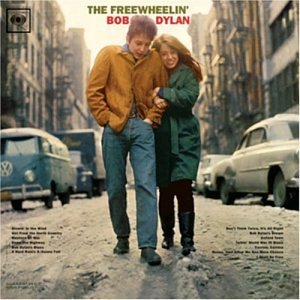
Now we’re getting somewhere. This set the tone for at least a couple of years, from the sly visions in the lyrics to the homespun photo of Our Hero arm in arm with his long-haired lady on a snowy Greenwich Village street. The Freewheelin’ Bob Dylan was his breakthrough, loaded with songs that still get cheers today whenever anybody does them.

“Blowin’ In The Wind” opens the side, and is probably why people love this album. Even after decades of saturation, the nine questions it asks can still provoke thought if one takes the time to consider them. “Girl From The North Country” uses fairly standard changes with a variation on the “Scarborough Fair” theme. It’s heartbreaking. Then we get “Masters Of War”, which is one angry little number, and still relevant today. “Down The Highway” is a straightforward blues song in open (out of) tuning. “Bob Dylan’s Blues” doesn’t have much to offer, but it’s just a stopgap on the way to the epic “A Hard Rain’s A-Gonna Fall”. Bob’s quoted in the liner notes suggesting that each line could be the opening to another song, and he’s right. Instead it provides a litany of imagery straight out of the Bible or Kerouac.

Side two has a tough act to follow, and it succeeds. “Don’t Think Twice, It’s All Right” uses a fast picking, probably courtesy of Bruce Langhorne, to accompany the kiss-off words. “Bob Dylan’s Dream” is more worthy of a namecheck in the title than its “Blues” counterpart, as the content goes a lot deeper than just one man’s dream. It’s a truly heartbreaking song of regret, thinking back to simpler times with lost friends that seem so far away. “Oxford Town” is a matter-of-fact protest song about race relations, but with a jaunty melody that belies the serious tone. “Talkin’ World War III Blues” has its moments, but doesn’t always warrant repeat listens. It’s still one of his better attempts at the genre. “Corrina, Corrina” is one of the few tracks released from the many sessions for this album—which took an entire year—featuring a “combo” backing; his sweet tone is a nice detour as well. “Honey Just Allow Me One More Chance” seems an odd choice, as it’s a cover, and he did the song better with different words on his debut. “I Shall Be Free” gives a final shot at comedy, not contained by the other talking blues songs. And it fades away to the inner groove.

The Freewheelin’ Bob Dylan goes a long way towards establishing him as a writer, even if the tunes and words are still very derivative of the usual folk repertoire. His growing fan base was able to watch him grow as well, as they wore out the grooves of this record. It’s a good leap forward from his first album, and he’d continue to explore the protest niche in the meantime.

The album is also groundbreaking in that it’s the first Dylan album of several that would be all but complete until some last-minute fiddling. The original version had four songs that would be replaced, three of which were a year olod at time of release, and they’re a mixed bag. First, the bluesy “Rocks And Gravel”, with an uptempo backing, was in the spot that “Girl From The North Country” took, and likely was the reason for the mistake in the liner notes referring to a band. Nice as it is, the replacement is preferred. “A Hard Rain’s Gonna Fall” came next, and sounds odd in the middle of the side instead of at the end, where “Let Me Die In My Footsteps” appeared. Instead of the sublime “Bob Dylan’s Dream”, “Rambling, Gambling Willie” was the second song on side two, and not missed. And because “Talkin’ John Birch Paranoid Blues” was considered too provocative, “Talkin’ World War III Blues” replaced that. It still would have been a heck of an album had it gone out, but then we wouldn’t have had “Masters Of War”. (Original copies fetched high prices among collectors; it was reissued on vinyl for Record Store Day in 2025.)

Bob Dylan The Freewheelin’ Bob Dylan (1963)—

Wednesday, April 15, 2009

Bob Dylan 1: Bob Dylan

As with many debut albums, Bob Dylan’s first full-length doesn’t necessarily have the same sound that made him famous. However, nearly half a century on, it fits squarely within the big picture as described by the rest of his catalog. Bob Dylan tries to cover a lot of ground, ending up something of a hodgepodge of blues and folk standards. It probably wasn’t too different from what the other Greenwich Village rats were up to, so whatever made him stand out so much doesn’t quite translate to wax.

“You’re No Good” starts the album on a jaunty note, with a harmonica solo in a different key; it must have been a crowd-pleaser and succeeds here. “Talkin’ New York” is his own composition, but that’s pushing it. The talking blues is fairly public domain as it is, the only difference being the words the singer adds—and many of these were taken from other songs. The best song on the album is “Baby Let Me Follow You Down”. He may well have first heard it from Ric Von Schmidt, but it’s the freshest thing here. The obvious debt is made clear in “Song To Woody”, which takes a familiar Woody Guthrie motif and turns it into a tribute to his mentor.

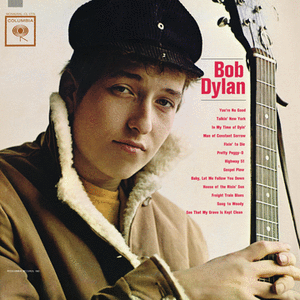
Barely twenty years old when the album was recorded, he had already adopted a husky tone to his voice that belied his youth rock ‘n roll adolescence. The smooth face on the album cover is an odd contrast to the man singing “Fixin’ To Die”, “In My Time Of Dyin’” (later covered by Led Zeppelin), “House Of The Risin’ Sun” (soon to be covered by the Animals) and “See That My Grave Is Kept Clean”. More successful are the more traditional “Man Of Constant Sorrow” and “Pretty Peggy-O”, and for a good example of his control before too many cigarettes, check out the held yodel note in “Freight Train Blues”.

If you’re looking for surreal wordplay, Bob Dylan isn’t the place to start. However, if you’ve enjoyed his folk and blues explorations, the likes of which have featured regularly in his live performances since the early ‘90s, it will make a lot more sense.

Bob Dylan Bob Dylan (1962)—3

Tuesday, April 14, 2009

Neil Young 27: Unplugged

Having undergone a solo tour in advance of the release of Harvest Moon, Neil’s promotion of the album consisted of several stabs at televised unplugged-type concerts. The last attempt was the best, and while perhaps it wasn’t really necessary, Unplugged still gets points for variety, rarity and quality.

He begins solo, bundled in leather jacket and with shades hiding his unshaven face. “The Old Laughing Lady” is performed almost jauntily, making it more like “Sugar Mountain” than the walking nightmare of the original track. He’d been doing it that way for years, but this was the first official appearance on an album, so it was welcome. “Mr. Soul” is reassessed in a drop-D modal tuning with harmonica that transforms it into a Delta blues number. “World On A String” is an odd choice, as is the first official release of “Stringman”, done identically to the shelved 1976 recording. (Keen listeners will notice that he performs four songs from Chrome Dreams in this set.) “Like A Hurricane” appears in its Dracula-pump organ guise before it wore out its welcome.

The band—including such luminaries from the past as Nils Lofgren, Nicolette Larson, Neil’s half-sister Astrid, and Kenny Buttrey, credited for union reasons as “Oscar Butterworth”—joins the proceedings for the Harvest Moon numbers plus some old favorites, as well as a fascinating take on “Transformer Man”. (The ever-faithful Larry Cragg came out to rhythmically push the broom for “Harvest Moon” itself.)

He’d been following his scattered muse through solo shows for years, and he found it on a good night. Strikingly crowd-pleasing and Neil-pleasing, the album also shows what the Unplugged series once strove for before it turned into a tired joke.

Neil Young Unplugged (1993)—

Monday, April 13, 2009

Neil Young 26: Lucky Thirteen

Since Neil had become so economically viable of late, it was hardly surprising when Geffen decided to cash in, and fast. Lucky Thirteen served to “sum up” the Geffen years. On the good side it has some rarities and alternates; on the bad side, the songs aren’t that good and the set doesn’t gel. The first of many references to “The Neil Young Archives” in the notes, plus several unreleased song titles scattered throughout the booklet only brought fans to the end of their tethers waiting for him to throw open the gates already.

The rarities are mixed at best. One’s enjoyment of the eight-minute version of “Sample And Hold” depends on how much one doesn’t hate the short version. “Depression Blues” is a sweet grower, left over from the initial Old Ways sessions, and a good indication of what the rest of the sessions sounded like before Neil poured on the schlock to piss off the label. “Get Gone” and “Don’t Take Your Love Away From Me” show how confusing the Shocking Pinks portions of his shows must have seemed; the former is a Bo Diddley stomp, while the latter predicts the Bluenotes. Several puzzling choices of album tracks follow, not even including such actual radio hits as “Touch The Night” or “Long Walk Home”. A pair of live Bluenotes tracks cap the set: “Ain’t It The Truth” is supposedly one of his earliest songs, but this version of “This Note’s For You” runs rings around the album track, given time to breathe rather than fading.

It’s fair to say that Lucky Thirteen is suitably irritating, as befits the era it sums up. These albums still have their defenders, though anyone’s choices from the period will vary.

Neil Young Lucky Thirteen (1993)—

Friday, April 10, 2009

Paul McCartney 14: Pipes Of Peace

It made perfect sense—war and peace, right? The follow-up to the successful Tug Of War, Pipes Of Peace came out in time for Christmas 1983 with a heavy emphasis on the duets with Michael Jackson, just when he was the biggest performer in the world hands down. Paul had already sung “The Girl Is Mine” with Wacko Jacko on Thriller; and Tug Of War sported two tracks featuring a Motown legend, so this does too. We’ll get to those.

The title track starts in a similar fashion to its counterpart, but gets derailed ere long by nursery-rhyme melodies and a children’s choir juxtaposed over Indian drums. At least the video had something to recommend it, but the song still sounds forced all these years later. “Say Say Say” has a lot more Michael than Macca, which probably explains its success, and it manages to be danceable without dating itself. (In the reverse of “Pipes”, the song is easier to swallow than the video.) And here’s where it all starts to really sink. “The Other Me” and “Keep Under Cover” barely have enough on their own to even turn into something worthwhile. Perhaps if he’d taken parts of each…no, that wouldn’t work either. “So Bad” might have been better served if he gave it to Jacko, or anyone else who wouldn’t sound so silly singing so high. To induce vomiting, seek out any of his interviews where he describes putting “boy I love you” in the lyrics to either humiliate or include his five-year-old son.

“The Man”, the other track with the future King of Pop, seems to be about someone very important, but damned if we can figure out who that is. “Sweetest Little Show” runs into “Average Person”, and both are equally as condescending as they are aggravating. (Though the latter might make folks pine for London Town, and it took years for us to notice that the fake horns motif at the end of each chorus was done better as the coda to “Tug Of War”.) “Hey Hey” is a dopey instrumental written with jazz cat Stanley Clarke, who wasn’t in a hurry to put it on any of his own albums. “Tug Of Peace” tries to unite the two big themes, and like some arranged marriages, succeeds only in wasting the time and attention of everyone involved. Luckily, “Though Our Love” is that One McCartney Song per album we’ve come to count on. Just gorgeous—but it’s too late. We’re already really pissed off.

Amazingly, George Martin signed off on Pipes Of Peace, easily Paul’s worst album in ten years. Some of these tracks were left over from the Tug Of War sessions, and it’s obvious why they weren’t used there. The better ones also appear in demo form on the Archive Collection bonus disc, along with a new remix of “Say Say Say”, the undeniably catchy “Ode To A Koala Bear”, and a few other underdone tracks from the same period. Of course, that didn’t stop the PR machine from touting Pipes Of Peace as an ‘80s classic, which it’s not. If we were in charge of these things, we’d’ve at least combined it with the new songs he’d earmarked for his first major motion picture (which we’ll discuss in due time), and pushed the demos over onto the concurrently released Tug Of War bonus disc, where they belong chronologically, rather than barely padding out both albums for the streaming generation. But this is what happens to performers who have spent decades doing anything they want. And in Paul’s case, it would only get worse.

Paul McCartney Pipes Of Peace (1983)—2
2015 Archive Collection: same as 1983, plus 9 extra tracks (Deluxe Edition adds DVD)