Saturday, December 22, 2012

Holiday Special #3: The Little Drummer Boy

When the LP gained prominence in the ‘50s, it was largely due the idea of a larger theme. Frank Sinatra had already been programming sets of songs for specific moods, and original Broadway cast became big sellers. So it only made sense that a 12-inch record (played at 33⅓) of Christmas music would convince the American consumer to part with two dollars. Sinatra did his part, as older 78s by Bing Crosby were transferred to the new format, and crooners like Nat “King” Cole and Johnny Mathis laid down their stamp.

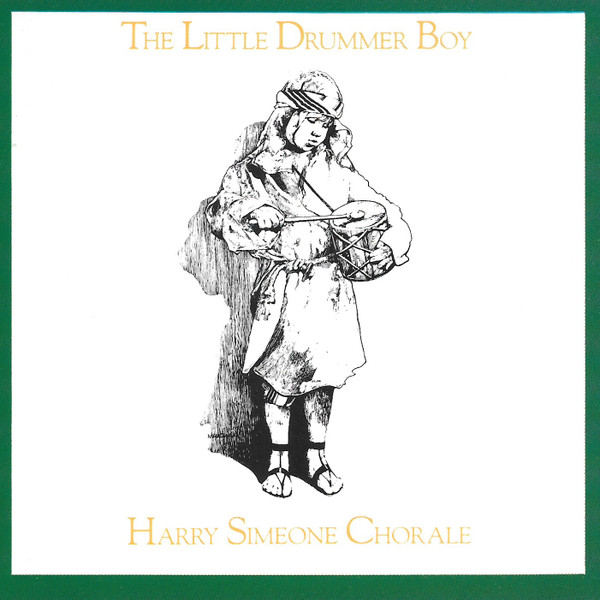
People were still writing new holiday numbers back then; it’s not an easy concept to get one’s head around, especially if the first songs you memorized as soon as you could talk were the tales of Rudolph, Frosty and Santa Claus. But somebody had to write those songs, and sat in smoky offices in the big city to do so. That’s how “The Little Drummer Boy”, an apocryphal retelling of a visit from three kings, came to be arranged and recorded by Harry Simeone and his hastily assembled chorale. (It would be another ten years before rock ‘n roll bands would try, and fail, to convert the idea of a drummer boy to the modern sound. And of course, ten years after that, David Bowie’s aversion to the song would force a team of TV writers to add an alternate descant to the melody.)

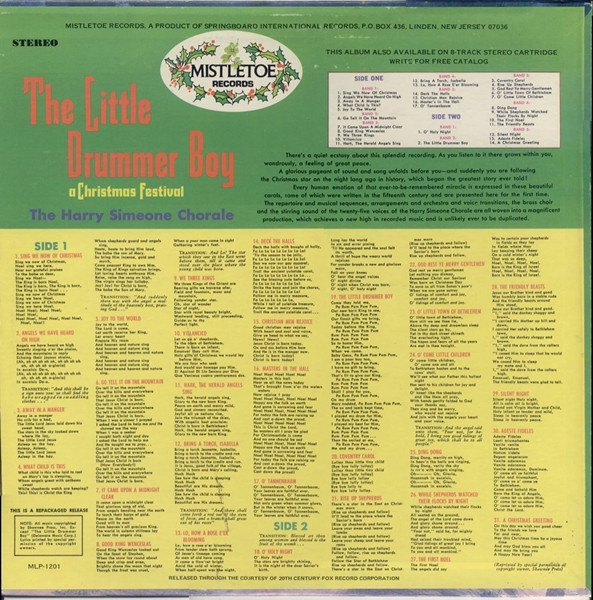
The song was a hit single, and included on an album called Sing We Now Of Christmas. After a few changes of distribution, somebody had the bright idea to change the title of the album to reflect the hit. As it turns out, outside of the title and cover art, the copy we grew up with has a back cover identical to the original release, from the blurb about the reason for the season and the complete lyrics to each of the songs on the album. It’s still in print today, with yet another cover from its tenure on the Casablanca label. Evidence of its first incarnation still exists on track six of the CD, where the “Sing We Now Of Christmas” theme appears again to set up what was side two.

What makes The Little Drummer Boy such an excellent Christmas album is its design: 31 different songs spread over the two sides, most consisting only of the first verse or so, giving the young music fan an easy way to become familiar with a wide variety of holiday music, from carols to hymns and spirituals and a few pop songs along the way. (This music fan loved the album so much that he’d attempt to listen to it all year round, a wish only granted when he got a record player of his very own, with a speaker small enough that it wouldn’t bother others in the house had he decided to play the album in July.)

Considering all the other Christmas albums that have been remastered and reissued over the years, it’s surprising (to us, anyway) that The Little Drummer Boy or whatever you want to call it hasn’t gotten the same love. The CD hasn’t been upgraded since its appearance in the late ‘80s, and even that sounds like it’s been transferred from a record. But it still set a high mark for other albums to follow, as demonstrated by Christmas Chorale. Given the choice, it’s the one we like to play on Christmas morning while opening the stockings and waiting for the coffee to brew.

Harry Simeone Chorale Sing We Now Of Christmas (1959)—
1963 LP reissue: same as 1959, with new title The Little Drummer Boy
1987 CD reissue: same as 1963

Friday, December 21, 2012

Kingston Trio: The Last Month Of The Year

Some of us who happened to be born when we did were forced to learn about much of the music on this blog well after the fact. We heard about the Beatles, Stones, Who and so forth on the radio, as our parents were too busy raising kids to experience the ‘60s. There was music in the house, to be sure, but their record collections were stuck in an earlier era—lots of Frank Sinatra and Henry Mancini, but also Christmas albums and, at their most radical, the Kingston Trio.

Compared with some of the other folksingers of the time, the Trio was fairly inoffensive—well-scrubbed young men with buzzcuts and matching shirts, looking for all the world like they’d met at a fraternity party at some small university. Their harmonies and pop sensibility made them safe for listeners of all ages, usually avoiding controversy and overt protest. (Though a single listen to “The Merry Minuet” will dispel any notions that they had their heads in the sand.)

There’s no doubt that they were talented, and each of the fellows were avid researchers of music from around the world to add to their repertoire. When they recorded what was basically a Christmas album, they naturally eschewed the type of songs that had been pop hits, presenting a selection of more obscure folk songs related not to Santa Claus but to December, The Last Month Of The Year. The theme of Christmas does run through the album, even on the lullabies “All Through The Night” and “Bye Bye Thou Little Tiny Child” (a.k.a. the Coventry Carol). “Goodnight My Baby” is a tad too upbeat to be a lullaby, but it does mention Saint Nick. The liner notes say that “Go Where I Send Thee” had its roots in Jewish and Christian traditions, but their version is definitely spiritual. “Mary Mild” is an odd little song about the boy Jesus being shunned by the neighbor kids for being born in a stable, masking the part of the story where the kids drown. “The White Snows Of Winter” is a gorgeous love song we’re surprised hasn’t been revived of late.

There are two songs we’ve only heard one other place—“Sing We Noel” and “Follow Now, Oh Shepherds” both appeared on the Harry Simone Chorale album a few years earlier. Other songs get unique treatments, such as “Sommerset Gloucestershire Wassail”. “We Wish You A Merry Christmas” is delivered round-style, matching the other side’s “A Round About Christmas”, which is the one about the goose getting fat and ha’pennies.

The album was apparently a sizable flop upon release, illustrated by its absence from the aforementioned record collection heavy on both Kingston Trio and Christmas albums. It stayed out of print for over thirty years, until Capitol rereleased the Trio catalog. After many of those were deleted, an oldie boutique label had it for a while. We must acknowledge the colleague that brought it to our attention during its limbo years, and we’re pleased to report that The Last Month Of The Year is available via the usual download outlets. Not quite the same as holding the LP/CD in your hands and reading/squinting at the liner notes while it plays, but at least the music can be heard. Which is good, because it’s wonderful.

The Kingston Trio The Last Month Of The Year (1960)—4
Current CD availability: none; download only

Thursday, December 20, 2012

Holiday Special #2: The Bells Of Dublin

The Chieftains are one of those mainstream outfits peddling their own brand of traditional Irish music, found once upon a time at most big box stores in the “Celtic” section next to the Clancy Brothers. After having something of a boost from Van Morrison, they released a series of albums that featured collaborations with a variety of established artists, all singing to their accompaniment. One of their nicer projects—surpassed only by The Long Black Veil a couple of years later, teaming them with the likes of Tom Jones and the Rolling Stones—was a Christmas album based around The Bells Of Dublin.

Besides presenting a pleasant selection of airs and graces (if you like that sort of thing), the collaborations were unexpected. Honorary Dubliner Elvis Costello contributes the gory tale of a family dinner gone wrong (not for the first or last time) in “St. Stephen’s Day Murders”. The McGarrigle sisters offer a medley of French carols, then Burgess Meredith sets up a Gaelic shepherds’ tale. Marianne Faithfull adds her sweet rasp for “I Saw Three Ships”—contrast that with Rickie Lee Jones, who sounds like she’s either on the verge of tears or a sneeze for “O Holy Night”. Jackson Browne had been quiet for a few years when he came up with “The Rebel Jesus”.

Beyond the “star” aspect, the traditional selections are the glue of the album. The Voice Squad lends support to several carols, as well as the extended dance demonstration of “The Wren” (even if singer Kevin Conneff sounds a little like Popeye on some of his scatting). The final section of blends three carols into a big finish on “O Come All Ye Faithful”, with the organist from a Belfast cathedral playing into those bells.

The Bells Of Dublin will likely irritate those who aren’t fond of Irish music, but we find it awfully soothing. As various CDs (and LPs) have gone in and out of our holiday stack over the years, this one is a constant.

The Chieftains The Bells Of Dublin (1991)—

Wednesday, December 19, 2012

Phil Spector: A Christmas Gift For You

While his name today generally is associated with a murder conviction or how he ruined “The Long And Winding Road”, Phil Spector really did make an impact on rock ‘n roll in his time. His “wall of sound” made dozens of instruments sound terrific on AM radio (in glorious mono) no matter who was singing. Brian Wilson used the same musicians and studio for his albums, and even Bruce Springsteen knew that he needed the Spector approach to make “Born To Run” the anthem that it is (which indirectly led to Meat Loaf and Bat Out Of Hell). But if Phil Spector did nothing else, he put together one hell of a Christmas album.

A Christmas Gift For You follows on the formula that drove “Be My Baby”, “Da Doo Ron Ron”, and dozens of other hits. Spector knew what worked and he did it to death (sorry), relying on repeated rhythms and musical motifs. This album is just like those singles; even though there’s a prominent sleigh bell in the percussion, it’s mixed just as high as the castanets and tambourine. On every track, all secular pop standards, you can hear Teenage Steve Douglas honking away on sax, Leon Russell’s piano octaves, and Hal Blaine’s thundering drums (and we assume it’s him doing the clippity-clop effects on “March Of The Wooden Soldiers” and “Santa Claus Is Coming To Town”). Jack Nitzsche is credited with the arrangements, so thank him for such touches as the 12-string that opens “Rudolph the Red-Nosed Reindeer”, the “Heat Wave” vibe on “Sleigh Ride”, and even “I Saw Mommy Kissing Santa Claus”, which begins with a sweet intro culminating in a loud smooch before barreling through the song, ending with a quote from “Rock-A-Bye Baby”. (“Winter Wonderland” ends with “Jingle Bells”, “Marshmallow World” with “Deck The Halls” and so on.)

Partially because of the tight rein Spector had on his roster, his main milieu was the single, not the album. So rather than have one artist carry the whole thing, A Christmas Gift For You rotates between Darlene Love, the Crystals, the Ronettes and the unfortunately named Bob B. Soxx & The Blue Jeans. Darlene leads off the program with “White Christmas”; already tackled doo-wop style by the Drifters, this adds a spoken bridge acknowledging what the holidays are like in “sunny L.A.”, far from the snow witnessed by many of the album’s listeners. She sings a total of four numbers, the winner being “Christmas (Baby Please Come Home)”, the only “original” song on the album, thankfully revived by U2’s version 25 years later.

While Darlene had arguably the best voice, Phil Spector was obsessed with Ronnie Bennett; without a doubt, her beehived, eyelinered delivery of “Fwawsty Da Snow Ming” (to the best of our phonetics) is guaranteed to stir the red blood of any teenage male. The other Ronettes provide the delicious “dinga-linga-linga-ding dong ding” on “Sleigh Ride”. The Crystals hold their own (“Santa Claus Is Coming To Town” is the arrangement Springsteen made standard, and we’re still wondering what “elephant boats” are) and Mr. Soxx doesn’t stick around long enough to bother anybody.

A lot of the intros are interchangeable, but so what? If you don’t like this album, you’re a Communist. There’s no need to describe every track since you’ve heard them already. Several songs appear in Goodfellas, which is probably playing on Spike, FX, or AMC right now. Apparently it was not a huge hit in its time, but it’s stayed in print all through the years, first on the Beatles’ Apple label, then through Rhino, ABKCO, and now on Sony. It’s still 35 minutes long, and it’s still in mono. The way it should be.

A Christmas Gift For You From Phil Spector (1963)—4

Tuesday, December 18, 2012

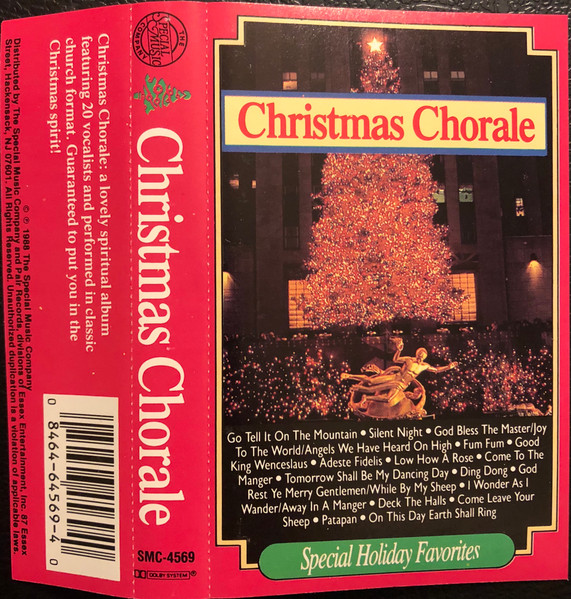
Holiday Special #1: Christmas Chorale

This is easily the most bizarre traditional Christmas recording we have ever heard. First heard on cassette circa 1989—one of those things you’d buy at a gas station for three bucks—the case had no production notes or credits, just a badly spelled track listing to go with the title and distributor (“Special Music”, and who are we to argue?). Starting with a bunch of people harrumphing amongst themselves with the occasional "Tell it on the mountain!" interjection, Christmas Chorale sounds like a small adult choir singing truly unique arrangements of hymns and carols to the occasional accompaniment of a spirited piano.

It’s not easy to express just how odd some of these renditions are. Beyond the performance art aspects of “Go Tell It On The Mountain”, there’s the logjam of “God Bless The Master/Joy To The World”, which does indeed combine those songs, with “Ding! Dong! Merrily On High” sung at the same time, but not necessarily in the same key. “Ding! Dong!” is reprised later in the program, with doorbell impressions woven into the arrangement. “Good King Wenceslas” appears to change time signature with every other measure, just as other familiar melodies are stretched and chopped to the point where it’s impossible to sing along.

A friend originally brought this album to the attention of your humble correspondent, and as far as we know, we are the only two people on the planet who have spent money on it and actually enjoy it. Over the years the mystery has only grown; who are the voices coming through the speakers? Did they snag any royalties from our purchase? Do they even know this album exists?

As often happens in the public domain, the contents have been repackaged and re-sold over the years, which might make our CD version a collectors’ item. (Stop laughing. Christmas is a time for wild wishes and outlandish dreams, after all.) The latest version of iTunes offers something of a clue, crediting a few of the tracks to Neville Garvey and the Los Angeles Chorale. A subsequent Google search only brings up various e-tail sites with what appears to be yet another permutation of the program. Some listings for Christmas Chorale credit the performance to the Royal Philharmonic Orchestra, which doesn’t make sense since the only instrument heard is that piano. Unless the choir is really the orchestra members singing. That would be something!

The closest we can figure out is that it might be the Los Angeles Master Chorale, who have had recordings released on a bunch of actual classical labels of merit, which takes away from our dream of some unknown community group that gather weekly somewhere in the Midwest to rehearse for sparsely attended concerts in front of retirees and bored children, while the best piano player in town dreams of playing on a real stage. Maybe some things are best left to the imagination. But what we wouldn’t give to be a fly on the wall at these rehearsals, the recording session, and the moment when the first box lot arrived with Christmas Chorale all shrinkwrapped and clean, poised to take its place in the pantheon of holiday music.

Christmas Chorale (1988?)—3

Monday, December 17, 2012

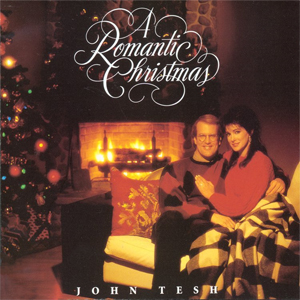
John Tesh: A Romantic Christmas

Well before VH-1 and “I Love The ‘80s” made snarkiness cool, there were a handful of cultural icons whose existence encouraged ridicule, and those of us of a certain generation remember our whipping boys fondly.

Sometime after John Tesh had established himself on the mass media map as the co-host of Entertainment Tonight, wacky ideas entered his oversized head. First, he asked New Age schlockmeister Yanni if he could join his touring band as a backup keyboardist. Then he started issuing a series of albums of his own, inspired by the Tour de France and such other exciting events. Finally, he stole TV’s Connie Sellecca away from Buck Rogers (TV’s Gil Gerard), a match made in Burbank.

The fruits of this domino effect were thrust upon the unsuspecting public with his seventh CD, a tribute to both the institution of holiday cash cow as well as the Neopolitan minx by his side. A Romantic Christmas was designed to simultaneously tug the heartstrings of America’s Hallmark shopper and yank the chains of those of us who zeroed in on the back cover photo of somebody’s lacy black undergarments (Connie’s, we hope) strewn about (but not too near) the hearth. Beyond that enticing image—since scrubbed, so don’t look for it—the album is lush, but not syrupy, consisting predominantly of hymns and carols performed without the melismatic passion of the average Kenny G album. While Tesh’s name is on the spine, and he’s credited with acoustic piano, the bulk of the program is supplied by the army of musicians in “his” orchestra, mostly supporting a prominent “classical guitar”. When that guy lays out, a boy’s choir sings just off pitch on three tracks.

The man gets kudos as early as track two, an arrangement of “Gesu Bambino” that the average consumer would know best from Luciano Pavarotti’s Christmas album, and a tune that hasn’t been overdone by everyone who thinks it’s a good idea to do a Christmas album. The rest are the usual pre-industrial yuletide chestnuts, designed to evoke memories of what we’ve been told the holiday must have been like in Victorian times, only with a little digital reverb. Tesh doesn’t really leave a hefty mark from his meaty paws until the two original tracks near the end of the hour-long program, both of which feature violinist Charlie Bisharat and both of which sound a little alike. The closing rendition of “Chestnuts Roasting On An Open Fire” is the closest we get to the expected Kenny G territory, given the soprano sax and fake electric piano accompaniment.

Given all that, A Romantic Christmas is actually pretty nice. If there’s anyone out there who can actually get it on with their lady to the strains of “Bring A Torch, Jeannette, Isabella”, we don’t want to know about it, even if they’re as photogenic as the Teshes. What makes the album worthy of a slot in your CD arsenal is its effectiveness as pleasant tree-trimming music—just as nice to have in the background while you’re trying to get in the spirit as it is should you decide to actually listen to it. Given all the potential of being an overwrought mess, it offers a soothing program, instead of something that inspires ridicule, which would be expected. Granted, we haven’t been able to build up the grapes strong enough to check out any of his other work—not least Sax On The Beach, Sax By The Fire, and Sax All Night. But even decades later, as ET still tries to pass itself off as news and his syndicated radio show attempts to inspire the typical Lite-FM listener on those evenings stuck in traffic after working late, A Romantic Christmas is a great way to win a bet. (As in, “Nice album, isn’t it? You won’t believe what it is when I show you the jewel case.”)

John Tesh A Romantic Christmas (1992)—

Friday, December 14, 2012

King Crimson 19: The ConstruKction Of Light

By the end of the century, King Crimson had evolved yet again. The “double trio” of Thrak was back down to a quartet along the lines of the ‘80s version of the band, with Adrian Belew on vocals and other guitar, Trey Gunn on the bass equivalent and Pat Mastelotto on predominantly electronic drums. The nature of that percussion pervades throughout The ConstruKction Of Light (the title being something of a nod to the interim “ProjeKcts” Fripp had encouraged among the double trio members, and the extra letter changing anything it can to “Kc”—cute, huh?). Unless we’re mistaken, and that’s not an impossibility, there’s no Mellotron to be heard anywhere.

The first track, “ProzaKc Blues”, has an excellent groove (and, as Crimheads like to point out, a standard chord progression) but it’s almost immediately undermined by a heavily processed vocal brought down about three octaves for comedic effect. While it’s nice to see that Fripp has a sense of humor—there’s even a nod to the longtime online mailing list dedicated to the band and their offshoots—what could have been a great opener instead dares the listener to continue. The title track is a big improvement. Split into two parts, intricate guitars answer each other in opposite speakers, and when the vocals enter in the second half, it’s more like the sound we’d normally associate with the Belew period. An appropriately sizzling effect starts off “Into The Frying Pan”, and there’s something about the wobbly vocals and guitars that sounds like psychedelic Beatles. Speaking of which, “The World’s My Oyster Soup Kitchen Floor Wax Museum” follows the type of free-association exercise that John Lennon indulged in during his househusband years—with some nods to the ilk of “Subterranean Homesick Blues”—with less than hilarious results. (Do you really want to hear the phrase “get jiggy with it” on a Crimson album?) While there’s no credit for keyboards, the last minute or so is dominated by an anarchic piano solo.

Belew’s lyrics being hit or miss, it’s more tempting to concentrate on the instrumental segments, which are lengthy. “FraKctured” is something of an update of the closing track from Starless And Bible Black, alternating extremely precise and urgent soloing with less edgy bridges. Even more provocative is “Larks’ Tongues In Aspic Part IV”, picking up the mantle of the title last revisited in 1984. Here the familiar stabbing theme is played with the aggression of Thrak. Indexed as three sections on your CD player, it segues neatly into “Coda: I Have A Dream” a la a similar postscript to “VROOOM”. The guitar is a little more mainstream, but the lyric little more than an update of “We Didn’t Start The Fire” with a sadder melody. (As a bonus/advertisement, “Heaven And Earth” is a glimpse into ProjeKct X, and the title track of an album excerpted from rehearsals and featuring the players on the album using a different approach. We’re guessing the title refers to the framing of the synth strings around the more aggressive middle.)

The ConstruKction Of Light didn’t kick down any doors, but still offered proof that Fripp hadn’t lost any of his edge over the years. If anything, the side projects, solo improv performances and vault explorations spurred him to always find something new. If you have everything else up to this point, it’s a worthy addition, but it’s not the place to start.

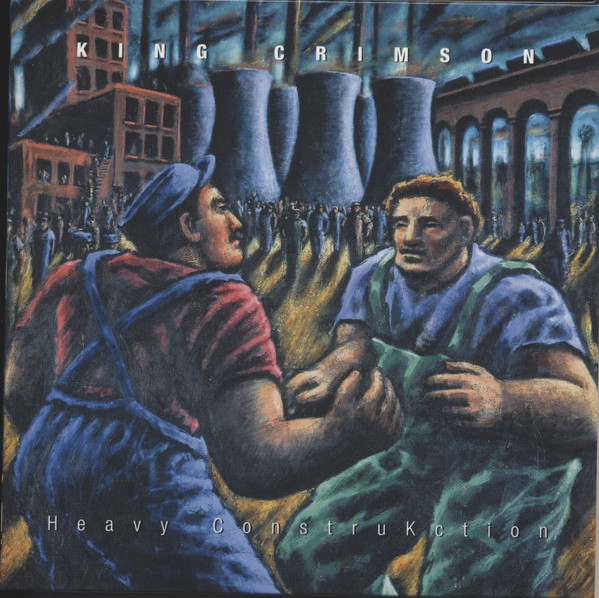
Two decades later, as part of the massive Heaven & Earth box set covering the band’s musical output in the early ‘00s (including that of various ProjeKcts), the album wasn’t just remastered and remixed, but rerecorded, as many of the digital masters had gone missing. Pat Mastelotto took the opportunity to redo his drum parts on a predominantly acoustic kit in place of many of the electronic parts on the original album. As a result, The ReconstruKction Of Light is that much more organic a listen, and a little less than two minutes longer. A cheaper option to hear the music in a more natural environment is Heavy ConstruKction, three discs of recordings from the band’s European tour supporting the album, one of which contains nothing but improvisations, two of those interrupted by the band stopping because audience members were taking flash photographs after being told not to.

King Crimson The ConstruKction Of Light (2000)—3
King Crimson
Heavy ConstruKction (2000)—3