Monday, May 30, 2011

The Strokes: Angles

When the Strokes debuted in 2001, they were hailed as saviours of rock, or more specifically the type of rock once pioneered by CBGB bands like Television, The Ramones and The New York Dolls. Their grimy appearance—tight T-shirts, torn jeans, Chuck Taylor high-tops and frizzy hair—belied their roots as the progeny of models, captains of industry and, in one case, a hit songwriter, and who’d all been to some of the finest private schools in New York City. The album still rocks a decade later, thanks to their tight riffing and frontman Julian Casablanca’s vocal style, best described as “a pizza delivery guy screaming into a broken intercom”.

But as has become sadly common in the modern day, they’ve only managed to put out three albums in the ten years since Is This It, each one a departure from the previous sound and none as exciting. Angles, one of the more anticipated albums of 2011, had a difficult birth, not least because none of the band members felt like working with one another. While such tension has led to amazing pieces of art in the past, that’s not the case here.

The first bad sign arrives with the new wave disco of “Machu Picchu”, which might please people who thought that sound was cool thirty years ago. There are a few good songs, like the near-power pop of “Gratisfaction”. “Under Cover Of Darkness” and the chorus of “Taken For A Fool” come close to capturing the wonderful vibe of such first album cuts as “Last Nite” and “Someday”. But along with the rinky-dink Casio keyboard sounds, most of the drums sound like they’ve come out of the same machine. Sometimes the combination of tentative guitar and mewling vocal suggest that they want to be Radiohead, and they’re not.

Coming in at less than 35 minutes, Angles is at least over quickly. It remains to be seen if The Strokes will ever be “great” again. But as long as their record company keeps throwing money at them, they don’t have to work very hard at all.

The Strokes Angles (2011)—2

Sunday, May 29, 2011

The over-500 mark

Last week Everybody’s Dummy passed 500 posts. We didn’t feel like counting how many actual albums were covered, but we know it’s more than 500. Thanks to those who’ve read any of them.

While we’ve “finished off” the catalogs of various artists covered here, rest assured that there’s plenty others on the way, some of which we’ll be tackling for the first time. Some can even be considered contemporary, if that’s at all possible or believeable.

We do still occasionally go back into the archives to check grammar and to see if any jokes have been used already; if anything, we don’t want to become redundant. Some posts deserved to be called out, as they have been expanded to reflect recent re-releases: the controversial upgrade of Exile On Main St. from the Stones, Tom Petty’s Damn The Torpedoes, David Bowie’s Station To Station, John & Yoko’s Double Fantasy and Paul McCartney’s Band On The Run.

The fact that these titles have been reissued (in some cases, for the third or fourth time) gives us reason to discuss a wearying trend in what’s left of the record industry. It’s annoying enough when a fan feels compelled to re-buy an album any number of times whenever “new” tracks are included, but it’s made even worse when the consumer is presented by what the labels insultingly consider a choice.

When the Zappa Family Trust puts out two versions of a massive documentary of the Freak Out! album, perhaps they can be excused for including a track exclusive to the two-disc edition, that’s not on the four-disc edition, since all the money’s going to them. (Apparently they’ve learned their lesson from the backlash, as subsequent archival digs have been simpler.)

But lately vinyl has had a resurgence, so labels have been reissuing so-called classic albums as high-quality LPs for the same list price as a full-length CD. In some cases, such as with Station To Station and last year’s Live At Leeds re-re-reissue from the Who, a “Super Deluxe” version of an album includes a vinyl pressing alongside extra CDs and/or DVDs, usually going for about $100.

The aftermath of the 2009 Beatle remasters (and iTunes availability) has opened the doors for the solo albums to be reconsidered. The latest versions of the Lennon catalog use the original mixes, but none of the extras included on the remixed CDs Yoko approved ten years ago. Any extras this time were only available in the “complete” box set. Similarly, when various Apple artists like Badfinger and Mary Hopkin were reissued last year, the bonus tracks were different from the early-‘90s CDs, with other rare tracks only available via digital download.

And now Paul McCartney’s muddying the waters as well. People who’d had previous versions of Band On The Run could be content with the CDs and DVD in the new Deluxe Edition for about $30 if they didn’t want to shell out for the Super Deluxe Edition, packaged as a hardcover book. But for the upcoming rejigs of McCartney and McCartney II, the pricey Deluxe Editions are the only place to get the DVDs; even worse, there’s a whole extra CD in the Deluxe McCartney II. With gasoline at $4 a gallon, just who do the labels think will be able to shell out for these $60 (or more) products?

On that happy note, we do hope you’ll keep coming back here to read about music you like, love, hate or have yet to hear. You’ll also notice that we’ve started a Twitter feed, which will not only alert you to new blog posts, but also have the occasional music-related link of interest. We live, after all, to give.

Saturday, May 28, 2011

Fripp & Eno 5: Beyond Even

Robert Fripp had already pioneered a system of releasing seemingly random selections from the deep King Crimson archives by the 21st century, and his Discipline Global Mobile operation would soon make further economic inroads by offering direct downloads. These extended to various of his non-Crimson ensembles and activities, so a 2006 compilation titled The Cotswold Gnomes, credited to Fripp & Eno, was an intriguing tease.

Described as “a sequence of sketches, out-takes, work in progress and alternative mixes,” its genesis was made clearer when the music was released on CD a year later as Beyond Even (1992-2006). Those who’d found The Equatorial Stars to be less than thrilling might have been more pleased with the breadth of styles undertaken here. Most of the pieces have percussion, so it doesn’t belong to the strictly ambient pile. The first few tracks burble along, then for the aptly titled “Sneering Loop” Fripp lets loose with a nasty riff. “Timean Sparkles” benefits from no percussion, and is closest to the quieter parts of Evening Star; “Hopeful Timean” sports contributions from bassist Tim Harries and is even quieter yet spookier. From time to time we hear some atmospherics reminiscent of Fripp’s albums with Andy Summers, blurring the lines further as to who did what on those particular albums. “The Idea Of Decline” recalls the “juju space jazz” of Nerve Net, but the latter half of the album leans to the spacey. Even the occasional energy of the first half is no match for the closer, the utterly explosive “Cross Crisis In Lust Storm”, which features ‘90s Crimso Trey Gunn on what we’ll assume is his trusty Chapman Stick. (Fripp rated his own contribution to this track very highly.)

Modern technology had of course made it much easier for people who were neither Fripp nor Eno to create automated loops and textures; still, these veterans get the benefit of being old hands at experimenting. Beyond Even is a nice peek for fans into their workshop. (A limited edition package offered the music two ways: one disc separated into individual tracks, with a few seconds of silence between each, and the other as a segued yet still indexed suite of continuous music. Even the artists’ own sites disagree as to what “disc one” is, but the streaming version is continuous, so there you go.)

Fripp & Eno Beyond Even (1992-2006) (2007)—2½

Friday, May 27, 2011

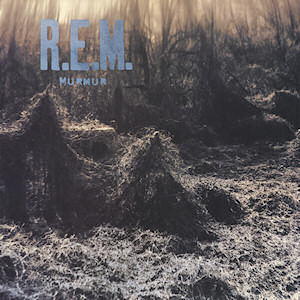
R.E.M. 1: Murmur

Once upon a time, a band would come along that obviously had its influences, but still sounded like nothing else. R.E.M. landed on mainstream FM radio with a tentative yet insistent single that also kicked off their first full-length album, beginning a love affair with its fans.

The album was Murmur, an apt title for a set of songs sung by a gruff vocalist more concerned with feel and emotion than being understood. The abstract lyrics of “Radio Free Europe” dance over a backing full of jangly Rickenbackers, melodic bass runs and steady drumming. “Pilgrimage” is a study in dynamics, adding some piano to an arrangement mostly following the bass. The bass also sets up “Laughing”, which meanders, apparently, around Laocoön and his two sons. “Talk About The Passion” opens with a catchy riff; the mumbled lyrics are even more impenetrable when they include fractured French. “Moral Kiosk” provides some edgy punk, but the big surprise is “Perfect Circle”. Beginning with twin pianos, this absolutely gorgeous melody is supported by gentle guitars and nicely muted drums. It even manages to end before the fade completes.

Side two gets off to a rocking start with “Catapult”, and continues with “Sitting Still”, giving bedroom guitarists a chance to play around with open E chords. “9-9” is a little cacophonous, but things get back to a high level on “Shaking Through”, which again features infectious guitar arpeggios, a strong piano and a great singalong chorus. After a short moody instrumental that sounds like an off-the-cuff jam, “We Walk” thunders in with a near-nursery rhyme, and “West Of The Fields” finishes things off with some urgent mystery.

Because of that mystery, it’s never easy to put R.E.M.’s abstract appeal into words. People get it or they don’t, and the band has experienced plenty of critical backlash. Yet for better or worse, they provided a different soundtrack for a generation not impressed with Michael Jackson, Cyndi Lauper and other video icons in bright pastels.

Murmur was not the band’s first release; that honor was shared by a self-produced 45 and a five-song EP that hip college kids already treasured; we’ll get to those soon enough. But for a debut, it remains a strong one. (The 25th Anniversary Deluxe Edition, approved by the band, includes a second disc of a Toronto concert from the tour following the album’s release. Nine of the album’s songs are mixed with a couple from the EP, and songs that would eventually appear on other albums.)

R.E.M. Murmur (1983)—4
2008 Deluxe Edition: same as 1983, plus 16 extra tracks

Wednesday, May 25, 2011

Joe Jackson 2: I’m The Man

Joe’s second album came hot on the heels of his first, and while it wasn’t as big a hit, it delivered songs nearly as good. The sound on I’m The Man is almost identical to that of Look Sharp!—edgy guitar, upfront bass and solid drums, but somewhere in the past six months he’d bought a melodica.

The opening salvo is an angry geek’s revenge on those who wronged him, now that he can be heard “On Your Radio”. Proof that he’s not just another new waver comes with the sophisticated storytelling of “Geraldine And John”, but he’s not above such simple popcraft as “Kinda Kute”. The second great song of his career is “It’s Different For Girls”, from the great opening line (“What the hell is wrong with you tonight?”) to the round of vocals at the end. The title track is a great punk stomper about, once again, commercialism.

“The Band Wore Blue Shirts” is an interesting look back at the days he spent toiling in clubs playing with any number of bands (much more detailed, again, in his memoir A Cure For Gravity). The portrait he paints seems even more quaint with each passing year. The contrast is even sharper with the infectious “Don’t Wanna Be Like That”, which crams his complaints about fashion, trendiness and sexuality into four minutes. Things slow down for “Amateur Hour”, a lament for an ambiguous subject. There’s another catchy “pop song” (it says so on the lyric sheet) in “Get That Girl”, and the band gets to show off again in the frenetic “Friday”.

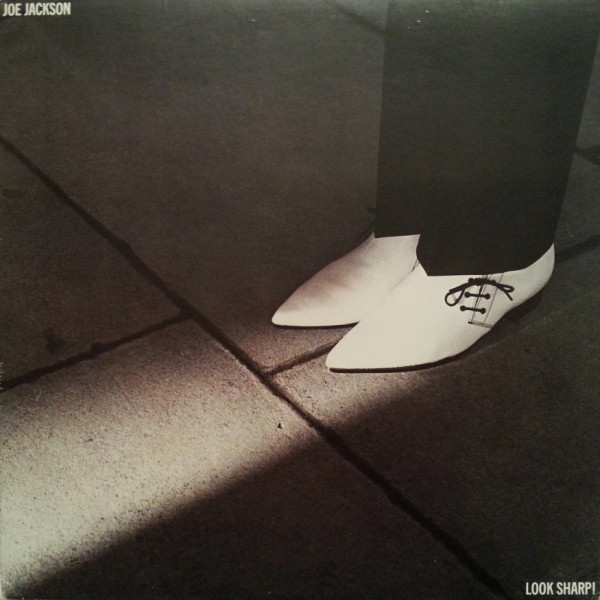
Though the math tells otherwise, I’m The Man seems short, but it’s pretty simple—if you liked Look Sharp!, you’ll like this, despite the ugly cover photo. It even came with a gimmick; similar to the first album, which was available as a double 10-inch vinyl package, this one was also released as a box set of five singles. (Not included was a live cover of Chuck Berry’s “Come On”, a contemporary B-side and now added to the latest version of the CD.)

Joe Jackson I’m The Man (1979)—3½
2001 CD reissue: same as 1979, plus 1 extra track

Monday, May 23, 2011

Joe Jackson 1: Look Sharp!

Joe Jackson was the last of the three angry young men to be attached with the skinny tie/new wave label, and just like Graham Parker and Elvis Costello, he did all he could to avoid such simple pigeon-holing. But a glance at the cover of Look Sharp!, his excellent debut, could excuse anyone for assuming he was just another lovelorn geek. That was only part of the story.

While he started out in the British pub-rock scene—see his excellent autobiography A Cure For Gravity for keen insights into this period—his influences were more, dare we say, esoteric than his contemporaries. For instance, Elvis Costello would soon betray a love for pop standards and country music, but Joe was more musical in his arrangements, not least because he was primarily a pianist. With a great interest in jazz and classical music (both of which he’d explore on record within ten years’ time) as well as prog-rock (which, thankfully, he’s avoided), his albums tended to be more engaging than confrontational. Still, Look Sharp! remains a New Wave classic, right down to the stylish packaging and edgy song selection.

“One More Time” kicks off with a slashing guitar and trebly bass, before a stop-time verse and harmonic pre-chorus about romance. Like all good punk rockers, he delivers a protest song (complete with harmonica solo) about the press in “Sunday Papers”, set conveniently in a household. The big hit was—and should be—“Is She Really Going Out With Him?”, designed for audiences to shout “where?” at the right moments while maneuvering past the eleventh chords. “Happy Loving Couples” continues the complaints about women (or the lack thereof) before getting cut off in the control room in favor of the pogo-tastic “Throw It Away”.

Side two kicks off in the dance club for “Baby Stick Around”, a wonderful Merseybeat pastiche. The title track is another snide swipe at fashion, even if structurally it’s dangerously close to Steely Dan’s “Josie”. Since most of London was in love with reggae in those days, that’s the sound that drives “Fools In Love”, a wonderful cross between “Watching The Detectives” and “Nature Boy” with a jazzy piano solo. “(Do The) Instant Mash” doesn’t quite live up to its title, but “Pretty Girls” manages to update “Do Wah Diddy Diddy” without copying it. “Got The Time” chugs along for a great closer, and gained some thrash metal-cred in the ‘90s after it was covered by Anthrax, of all people.

As good as Look Sharp! still is today, it could have easily been a one-hit wonder. His resistance to categorization would keep new fans on their toes, while his excellent band—anchored by the incomparable Graham Maby on bass—were keen to keep up with him. But for now, he could say he recorded one fine album. (A later CD reissue, which hardly anyone noticed, added two B-sides to the program.)

Joe Jackson Look Sharp! (1979)—4
2001 CD reissue: same as 1979, plus 2 extra tracks

Friday, May 20, 2011

Van Morrison 1: Them

As a youth in Belfast, Van Morrison was obsessed with jazz and rhythm & blues, but by the time bands like his were getting noticed, record companies were looking to jump on the British Invasion bandwagon. So over the two years and two dozen players who passed through their ranks, Them were tasked with making hit singles out of their brand of British R&B—kinda like the Animals. Producer and songwriter Bert Berns came over from New York to cash in, sometimes using one Jimmy Page to bolster the studio sound.

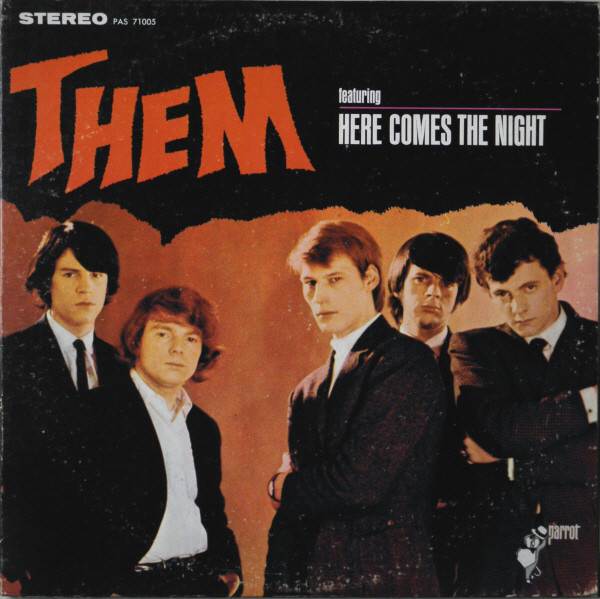
Somehow the Van-penned B-side of “Baby Please Don’t Go” became a huge hit (and garage band staple) on both sides of the pond, and since America was all about hits, “Gloria” was emblazoned on the cover and among three single sides added to the distillation of the excellently titled British album The Angry Young Them. It was placed at the end of side one, which began with Berns’ “Here Comes The Night”, another hit with a distinct Sam Cooke influence in the vocal. Berns also foisted “Go On Home Baby”, which features rare harmonies from another band member, on them. John Lee Hooker’s “Don’t Look Back” is a cool ballad with tasty piano, and the prominent organ of “I’m Gonna Dress In Black” makes it very much an Animals soundalike. “(Get Your Kicks On) Route 66” had already been claimed—and nailed—by the Stones.

Of Van’s own songs, “Mystic Eyes” is the standout, basically a two-chord jam with a seemingly extemporaneous recital that’s a forerunner to his later, longer ruminations. (“Little Girl” isn’t as successful, and “One Two Brown Eyes” is more notable for its slide guitar effects.) “One More Time” and “If You And I Could Be As Two” are attempts at seduction, stuck between belting and speaking, and “I Like It Like That” mostly meanders.
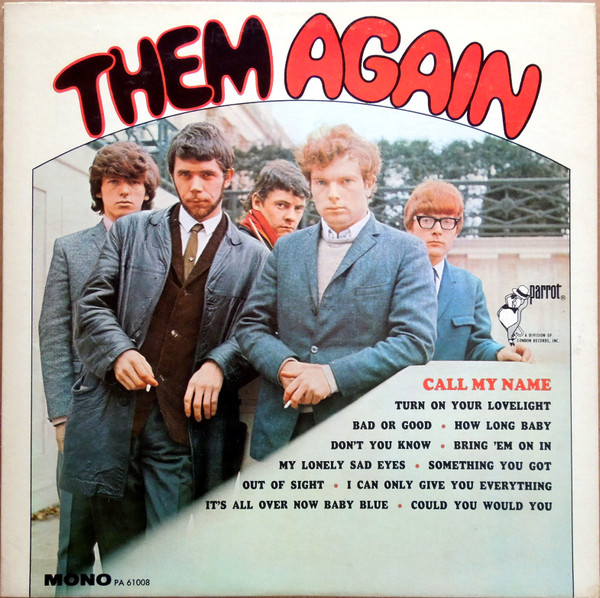
Less than a year later, Them Again shaved the British version down to twelve tracks, still split between Van originals and covers. Of these, their moody take on Dylan’s “It’s All Over Now, Baby Blue” is the clear winner. Chris Kenner’s “Something You Got” has a sax solo that might be Van, and these days it’s interesting to hear “Turn On Your Love Light” and consider that Them’s version could be what inspired the Dead to do it. “I Can Only Give You Everything” is a trashy variation on the usual garage riff, and “Out Of Sight” is the closest they got to being James Brown. Tommy Scott was now their producer, so four of his songs made the album. “Call My Name” and “How Long Baby” are rather ordinary, but “I Can Only Give You Everything” has a cool snotty riff, and the flute and piano on “Don’t You Know” predict “Moondance”.

Van himself was limited to four songwriting credits. “Could You, Would You” with its powerful drum fills opened the album, and the double acoustic guitar on “My Lonely Sad Eyes” almost makes it folk-rock. “Bad Or Good” is nice and soulful, just as “Bring ‘Em On In” is defiant.

Management issues and general disinterest led to the band splitting into factions on tour, and ultimately Van went off to be a solo artist of merit, which meant that various repackages of Them material popped up throughout the ‘70s. The first, 1972’s Them… Featuring Van Morrison, excerpted ten songs from each of the American albums but in reverse order, with dense liner notes by Lester Bangs in phone book-size type across the inner gatefold. Two years later, Backtrackin’ helpfully offered up ten tracks that weren’t on either of the American albums, including such singles as “Baby Please Don’t Go” and their cover of Simon & Garfunkel’s “Richard Cory”, as well as “Hey Girl” (another flute-laden precursor to “Cyprus Avenue”) and the previously unreleased “Mighty Like A Rose”. Three years after that, The Story Of Them offered nine more of the same, mostly blues covers but also the rare title track, a rambling memoir in changing keys originally split over two sides of a single but here continuous, the early EP track “Philosophy”, and the lovely late single “Friday’s Child”.

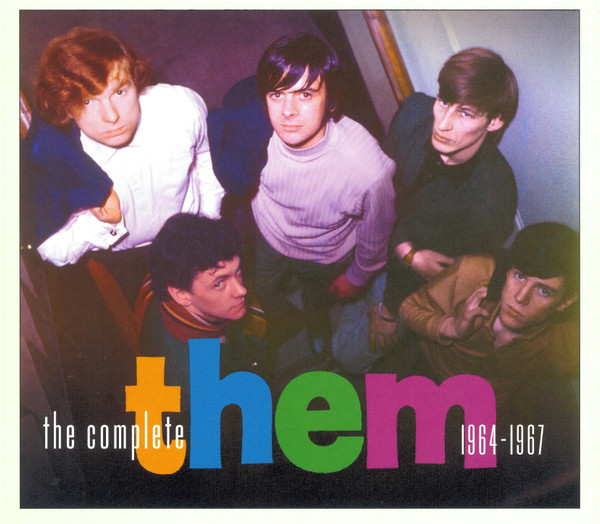
Eventually, The Best Of Van Morrison included “Gloria”, “Baby Please Don’t Go”, and “Here Comes The Night”; Volume Two offered “Don’t Look Back” and “It’s All Over Now, Baby Blue” amidst songs from the ‘80s simply because Polydor still had the rights to them. Another attempt to tell The Story Of Them Featuring Van Morrison on two CDs had to navigate mono mixes and stereo remixes, and still seemed to be somewhat random in its sequencing. It wasn’t until the band’s 50th anniversary (and Van’s partnership with Sony Legacy) that The Complete Them 1964-1967 presented a full chronological overview, with all of the singles and album tracks in context on two discs, and a third devoted to previously unreleased demos and select alternate takes and BBC sessions. Van even wrote the liner notes. Getting to hear the singles in release order doesn’t take away the haphazard construction of the albums, even in the British sequences, but we do hear his voice and songwriting improve.

Them Them (1965)—3
Them
Them Again (1966)—3
Them
Backtrackin’ (1974)—2½
Them
The Story Of Them (1977)—2½
Them
The Complete Them 1964-1967 (2015)—3