Wednesday, October 31, 2012

Frank Zappa 10: Weasels Ripped My Flesh

Another archival dig appeared only six months after Burnt Weeny Sandwich. If that album presented a comparatively easily digestible look at the Mothers, Weasels Ripped My Flesh lives up to its great title with a more, shall we say, challenging experience. The majority of the contents come from the various directed improvisations typical of Mothers concerts, once the band was big enough to keep things from getting too off-kilter.

Things get challenging right away with “Didja Get Any Onya?” An odd-metered stomp gives way to a monologue with a German accent, a few rounds of “MOO-AH” leading to the song title, and even a segment recognizable to owners of Trout Mask Replica as music from “The Blimp”. There’s an abrupt switch to “Directly From My Heart To You”, an obscure Little Richard B-side sung here by Sugarcane Harris, also on electric violin. Just as that dirty blues comes to a halt, “Prelude To A Sexually Aroused Gas Mask” crashes through atonal chords, snorks and Roy Estrada’s operatic yodeling over a Mozart piece tinkled on electric piano. “Toads Of The Short Forest” has about a minute of tightly constructed music from the studio, before going back to a stage where we hear, Frank tells us, “drummer A playing in 7/8, drummer B playing in 3/4, the bass playing in 3/4, the organ playing in 5/8, the tambourine playing in 3/4, and the alto sax blowing his nose.” A slow jam puddles along until Frank announces a short break. A good way to end the side.

The song titles alone will stick in your head long before the music does, and that’s certainly the case with “The Eric Dolphy Memorial Barbecue”, a tribute to the jazzman wandering from slow to frenetic. “Dwarf Nebula Processional March & Dwarf Nebula” would appear to be a leftover from Uncle Meat, the intro a nice little horn piece, the rest giving way to sped-up and edited tape. “My Guitar Wants To Kill Your Mama” is an alternate take of a song released the year before as attempt to crack the top 40, complete with tasty acoustic solo. “Oh No” is an old melody that had appeared a couple of times on Lumpy Gravy, here given a lyric skewering the “peace and love” statements of the time, with the return of Ray Collins on lead vocalizin’. There’s a seamless jump to “The Orange County Lumber Truck”, which itself seems to have evolved from jams on “Let’s Make The Water Turn Black” and “Harry, You're A Beast”. It’s one of the more tuneful parts of the album, so it only makes sense that it leads to the title track—two minutes of sustained noise before Frank bids the “boys and girls” good night.

It has yet to be determined what exactly else Frank had planned for his multi-disc Mothers retrospective, as he was soon distracted by a new version of the band, new material, and yet another movie. Although Weasels Ripped My Flesh isn’t as immediately accessible as Burnt Weeny Sandwich, the high points are enough to help you endure the more trying moments. Collectors will note that it was the first Zappa album not to be released in a gatefold sleeve; everybody else will agree that the cover is pretty hilarious.

The Mothers Of Invention Weasels Ripped My Flesh (1970)—3½

Monday, October 29, 2012

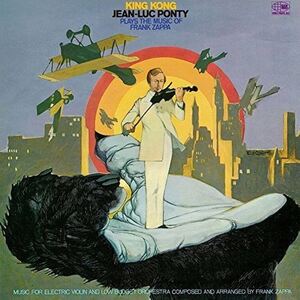
Jean-Luc Ponty: King Kong

One oddity that crops up in the Zappa discography is an album credited to jazz violinist Jean-Luc Ponty. King Kong (subtitled “Jean-Luc Ponty Plays The Music Of Frank Zappa”) presents some familiar and not-so-familiar melodies in a modern jazz environment. Ponty had already appeared on Hot Rats, while Frank had been incorporating electric violin into the Mothers as well. The musicians are a cross between jazz cats and such Mothers as Ian Underwood and Art Tripp. The album’s also important to the history, as these were the sessions that introduced Frank to George Duke, who would go on to be a valuable contributor to the ‘70s version of the Mothers. Because of Frank’s involvement in the project, it can almost be seen as a cousin to Lumpy Gravy, without the dialogue, as a way to present himself as a serious composer. (In fact, several session musicians appear in the orchestras for both that album and this.)

The title track sounds much as it did on Uncle Meat, kicking right out of the gate, to the point where one might be surprised it’s not from a textbook Zappa album. George Duke’s electric piano fits right in, as he would for much of the decade. “Idiot Bastard Son” is a surprising choice, considering the original lyrics, but here the construction of the song shows off its musicality. “Twenty Small Cigars” makes its debut here, in a slow down-on-your-luck ramble that helps one find the melody on the Zappa version out soon. Frank himself appears to add some guitar to “How Would You Like To Have A Head Like That”—a Ponty composition despite the Zappa-worthy title.

“Music For Electric Violin And Low Budget Orchestra” runs for over 19 minutes, and would appear another in a line of attempts to combine some of his long-gestating classical works, “Pound For A Brown” and “Duke Of Prunes” being just two of the melodies familiar to fans, with a few trademark honks placed in the score. “America Drinks And Goes Home” presents the chaotic Absolutely Free track in a somewhat clearer frame, but just as nutty.

We don’t know what jazz aficionados feel about this album, but for the Zappa story it’s as notable a footnote as any of his other tangents, if only as a document of his quest for respect as a composer. Its rating below should therefore be taken well inside that context.

Jean-Luc Ponty King Kong (1970)—3

Friday, October 26, 2012

Jimi Hendrix 7: Hendrix In The West

After two vault-scrapings, somebody decided that a live album might be a decent way to make money off a dead Hendrix. Rather than highlight a single performance, thus began the practice of siphoning songs from the hundreds of concerts he’d played, sticking in this case to the Isle Of Wight Festival and Berkeley from 1970, and San Diego and the Royal Albert Hall from 1969 with the original Experience. (We haven’t figured out the significance of the title Hendrix In The West, seeing as only half of the album was recorded on that American coast; from an overseas standpoint, he pretty much only performed in the Western Hemisphere, so the mystery remains.)

For the most part, the album doesn’t concentrate so much on the obvious, but does present him at the peak of his inspiration. The opening “God Save The Queen/Sgt. Pepper” medley from the Isle of Wight Festival (issued several times everywhere, but not in the US until 2002) is meant as a simple warmup, and the crowd responds happily. “Little Wing” is short but sweet, but “Red House” keeps your attention for thirteen minutes, from quiet to screaming, steady all the way. (It’s Jimi’s name and photo on the cover, but the excellence of Mitch Mitchell, Noel Redding and even Billy Cox should not be underestimated.)

A more impromptu “Johnny B. Goode” is delivered with plenty of fire, followed by a blazing take on “Lover Man”, making its album debut. An incredibly funky groove somehow leads to a take on “Blue Suede Shoes” (from a soundcheck, which probably explains the fade) and the set closes with an especially hot “Voodoo Child (Slight Return)”, which also fades for some reason.

Hendrix In The West is a solid album, but our cynicism over the motivation is underscored by the sloppy presentation. Besides seeming to be in a different sequence in every country, the compilers tried to pull a fast one by crediting the Albert Hall tracks to San Diego, resulting in a legal issue that kept the two Albert Hall tracks from appearing when the estate reissued the album nearly forty years later (not surprising, considering how many times that show had been recycled on countless no-name labels). So “Little Wing” appears instead from the Winterland shows, and “Voodoo Child” comes from San Diego. Three more songs from San Diego fill up another 20 minutes on the CD, leading us to wonder why they didn’t use the other two songs from the show, which had appeared on an official box set in the early ‘90s, just before the estate took everything back. Since so many of the tracks are available elsewhere, the album’s relevance today has been lessened. But it’s still pretty damn good.

Jimi Hendrix Hendrix In The West (1972)—4
2011 version: same as 1972, plus 5 extra tracks (and minus 2 original tracks)

Wednesday, October 24, 2012

They Might Be Giants 1: They Might Be Giants

Arguably, a band can be considered successful when they divide the public into two distinct groups: those who like said band and those who hate them. Such has been the case for They Might Be Giants for close to three decades. Success hasn’t spoiled them—in fact, it’s barely touched them—and their champions are grateful for that.

TMBG (as their fans call them, and it’s a lot easier to type so we will too) began as two guys named John presenting a truly original version of geek-rock, with the accordion being a central instrument and their tendency toward songs about science and American history. Imagine Ween without the drugs and you’re almost there. With one John handling the stringed instruments and the other tackling keys and horns, their earliest shows were accompanied by a meticulously programmed drum machine. Considering the processing that real drums had received in the ‘80s, the percussive sounds heard on their self-titled full-length debut album don’t sound any more fake that many other records of the time.

The album crams 19 songs into a program just under 40 minutes, and it’s safe to say nothing sounds like anything else. Many of the songs debuted on their “Dial-A-Song” answering machine greetings, so brevity was the soul. As many of the songs are simply sketches and not Grand Works of Art, a brief synopsis of the more substantial ones will have to suffice.

“Everything Right Is Wrong Again” is a built-in contradiction, using a plot point from the Lucy-and-Desi film The Long, Long Trailer as a key chorus element. Their first “hit”, “Put Your Hand Inside The Puppet Head”, crashes that away, and “Number Three” aptly delivers the third song in a transition to the next “hit” in “Don’t Let’s Start”. “Hide Away Folk Family” is one of the longer tracks on the album, with a round-style chorus, and the discovery too late that a backwards accordion doesn’t sound too different from a forward one. “Nothing’s Gonna Change My Clothes” and “I Hope That I Get Old Before I Die” are full of the wacky lyrics, music references and rhythm changes fans love. “(She Was A) Hotel Detective” gets a way-over-the-top vocal for a song that doesn’t deserve one. Being good pioneers of modern recording, “Boat Of Car” includes a Johnny Cash sample, while “Absolutely Bill’s Mood” is built around a literally phoned-in guitar solo.

They Might Be Giants didn’t set the world on fire, but it fit in perfectly with the rest of the stuff on college radio before the term “alternative” was coined. Our general impression is that one of the Johns didn’t take himself as seriously as the other, but for the most part they complement each other nicely. The album is like the people who created it: you’ll either like it or you won’t.

They Might Be Giants They Might Be Giants (1986)—3½

Monday, October 22, 2012

King Crimson 16: Thrak

The digital era gave Robert Fripp another reason to assess the legacy of King Crimson, resulting in remasters of the catalog and some archival digs in box set form. But the big news arrived in 1994, with the announcement of yet another lineup performing as King Crimson. This time the ‘80s combo, featuring Adrian Belew, Tony Levin, and Bill Bruford—each of whom had kept very busy in the meantime—was augmented by drummer Pat Mastelotto and Chapman Stick player Trey Gunn, both of whom had most recently toured with Fripp and David Sylvian. This “double trio” format managed to contain enough elements of each previous incarnation of the band to earn the right to use the moniker.

The new album was preceded by a self-produced EP, which would recur down the line, and also confirm Fripp’s belief that the least label interference was best for him. VROOOM (yes, rendered in all caps) is mostly a first draft, teasing listeners with the potential of the band as they jam towards a result. (A further glimpse into the rehearsal stage would be provided in four years via the eighth volume of the King Crimson Collectors’ Club.)

Thrak (also occasionally given the all-cap treatment but we don’t want to) is a much more polished and better balanced program, building on the foundation of VROOOM. It begins the same way, with a quiet rumble and crashing in on the pounding theme of “VROOOM”, beginning with a melody right out of Red and pausing for a few fingerpickings. The second half of the track is now “Coda: Marina 475” ever descending to its end. The glorious sound of Mellotron strings heralds “Dinosaur”, the first vocal appearance of Adrian (and a very Lennonesque one at that) and a terrifically catchy should-have-been-a-hit. The Mellotron reappears halfway through in a suggestion of Barber’s “Adagio For Strings”, setting up a false ending before the chorus reappears. “Walking On Air” is another radio-friendly tune, with a lovely backwards-sounding solo. “B’Boom” is mostly a drums solo leading into the title track, another insistent riff.

The second half of the album is more vocal-oriented: the two halves of “Inner Garden”, the driving funk of “People” (which really takes off in the last couple of minutes’ solo), the slinky “One Time”, and the Peter Gabriel-ish “Sex Sleep Eat Drink Dream”. “VROOOM VROOOM” and its coda provide more variations on the opening salvo, bringing things nicely full circle.

By tempering Adrian’s voice (or piling more sound around him) the ‘90s Crimson seems to rock more than ever, pretty much picking up where the band left off in the ‘70s, without relying so much on the electronics of the ‘80s. They certainly sounded like they were having fun, and now that they had the technology, many of the concerts performed by the double trio would become available for purchase directly from Fripp’s website, while a few would get wider release. B’Boom documents a show in Buenos Aires that occurred just before the Thrak album proper was recorded, and rush-released to thwart bootleggers, while VROOOM VROOOM provides performances from each end of the lengthy tour to promote the final product, all without a lot of overlap. (THRaKaTTaK is basically a bunch of improv experiments from various shows, chopped and mixed Zappa-style, and for obsessives only.)

For even more fun, a box set devoted to the lifespan of the double trio contains 12 CDs, two DVDs, and two Blu-rays, presenting just about everything they recorded in the studio and several things captured onstage over the space of four years or so. Meanwhile, the 40th Anniversary Edition of the album stuck with the album as released, but piled various mixes onto the DVD.

King Crimson VROOOM (1994)—3
King Crimson
Thrak (1995)—4
King Crimson
B’Boom (1995)—3½
King Crimson
VROOOM VROOOM (2001)—3

Sunday, October 21, 2012

Robert Fripp 6: The Next Day

David Sylvian was best known as the dreamy frontman for the New Wave band Japan; he became better acquainted with Robert Fripp after doing a session together in 1985. At the turn of the ‘90s, Fripp had toyed with the idea of another incarnation of King Crimson, with Sylvian as lead singer. While that didn’t happen, the two did manage to complete a collaborative tour, which resulted in an album.

The Next Day is very much a collaboration, dominated by Sylvian’s croon, over loops as well as real drums and percussion, with Fripp mostly adding color on the side when he’s not driving the riff. Another key contributor is Trey Gunn, who’d graduated from Crafty Guitarist to proficient Chapman Stick player and had joined the duo on the initial tour. Veteran drummer Jerry Marotta is also on a few tracks, along with computer treatments from co-producer David Botrill.

The album begins with the funky (always a strange word to associate with Fripp) “God’s Monkey”. But for the experiments in meter, this is fairly mainstream, as is “Jean The Birdman” with its dense lyrics. “Firepower” brings in a lot more crunch, and sports more familiar Fripp soloing that livens up the second half of this ten-minute track. (Plus, what sounds like a violin evokes echoes of the Larks’ Tongues era.) Another snaky riff drives “Brightness Falls”, which is just too slow to be danceable.

The second half of the album is a little more indulgent, if frankly tedious. “20th Century Dreaming (A Shaman’s Song)” has promise at first, but soon devolves into ambient effects while the bassline burbles beneath. Not so for “Darshan (Road To Graceland)”, which explores the era’s ubiquitous “Manchester beat” loop for about 17 minutes. It picks up anytime Sylvian sings an actual verse or Fripp’s guitar comes up in the mix, but takes up a lot of space without really going anywhere, despite the title. If anything, it makes the Frippertronic soundscape of “Bringing Down The Light” more welcome.

To support the album, the duo plus Gunn recruited “infinite guitarist” Michael Brook and Pat Mastelotto, most famous for pounding the skins for Mr. Mister, for another brief tour. The shows at the Royal Albert Hall were released as a limited edition CD called Damage, which Sylvian remixed and resequenced in 2001 for a more widespread release. The first version gets points for beginning with the moody title track, while the second adds “Jean The Birdman” at the expense of “Darshan”, which also cuts six minutes from the total disc time. Both versions provide better performances of the album’s tunes, plus a few selections from Sylvian’s solo albums as well as a song from Rain Tree Crow, the eponymous Japan reunion from 1991. In both cases, the albums end with two more rare songs: the rocking outtake “Blinding Light Of Heaven” and the much more subdued “The Next Day”. (Completists will also want to seek out the two CD singles for “Jean The Birdman”, which include more subdued Sylvian tracks with Frippertronics, and the “Darshan” maxi-single with two commissioned remixes of the song that are actually shorter than the album track.)

Though the pair wouldn’t take their collaboration further, the rhythm section would continue to be useful for Fripp. And while The Next Day and particularly Damage very much foreshadowed his next adventure, that future would be very different indeed had Sylvian accepted the challenge of singing in King Crimson.

David Sylvian & Robert Fripp The Next Day (1993)—2½
Sylvian/Fripp
Damage (1994)—3

Saturday, October 20, 2012

King Crimson 15: The Great Deceiver

While it covered all the lineups King Crimson sported over the years, the Frame By Frame box set stuck mainly to album tracks, with the one disc of live material limited to three of those incarnations. The era of the band that begun with the Larks’ Tongues In Aspic album was particularly revered by both audiences and Robert Fripp himself, so he took the opportunity to curate another box set, this time devoted to that quartet. The Great Deceiver highlights six shows, some complete, throughout four discs. While the repertoire is similar, we get to hear just how differently Fripp, John Wetton, David Cross, and Bill Bruford approached each performance. Fripp makes no apology for including four versions of “Easy Money”, though it is something to experience two different audiences hearing “Starless” for the first time—and with violin.

The first disc presents the penultimate gig by the band, completed at the start of disc two. (Even the “Walk On” and “Walk Off” music from (No Pussyfooting) is included for posterity.) This show was the source of “Providence” on Red, presented unedited here, and “21st Century Schizoid Man” on USA, where it was overdubbed. In those days Fripp would actually engage the crowd with announcements, and here his introduction of a well-received improvisation called “A Voyage To The Centre Of The Cosmos” is peppered with his own chuckles.

The bulk of the second disc comes from nine months earlier in Glasgow, and includes the full improv that would be edited and titled “We’ll Let You Know” on Starless And Bible Black. Here the opening jam before “Larks’ Tongues Part One” is called “Sharks’ Lungs In Lemsip”; another improv gets the title “Tight Scrummy” and is built around an almost comically prominent rhythm machine. A surprising encore arrives with Fripp strumming “Peace: A Theme” before the band goes into “Cat Food”. Ten minutes of material from a later show at Penn State fill up the disc, and stay tuned for a hidden track wherein Fripp signals engineer George Chkiantz to change tapes.

Disc three is devoted to a show from Pittsburgh with a rowdy audience. Here the “Walk On” music is smacked away by a furious “Great Deceiver”, but having to tune the Mellotrons quiets the proceedings down quickly into one improv. “Exiles” builds the tension, but Fripp follows that with a pretty piece for guitar and violin dubbed “Daniel Dust”. Things pick up for “Doctor Diamond”, a mushmouthed original that never really gelled. An improv called “Wilton Carpet” moves into “The Talking Drum” and then an “abbreviated” “Larks’ Tongues Part Two”. (Another fourteen minutes from Penn State end the disc, consisting of another announcement from Fripp asking “Is there life out there?”, whence the following improv gets its title; another hidden track demonstrates further onstage tuning of two Mellotrons.)

Disc four opens in Toronto with a furious (there’s that word again) piece called “The Golden Walnut”, which sports a riff one day better knows as “One More Red Nightmare”, and eventually dwindles to silence. After “The Night Watch” and “Fracture” comes another improv, cheekily dubbed “Clueless And Slightly Slack”, and a phrase used throughout the booklet. From there we go a Zurich show for plenty of improvisation, one of which is called “The Law Of Maximum Distress” and split into two parts due to a missing tape. As it turns out, that missing piece had been chopped out of the master back in 1973 to be overdubbed as “The Mincer” on Starless And Bible Black. Further dying Mellotron fuels the prelude to “The Talking Drum”, which ends abruptly, along with the entire set.

Once again design was treated with the same respect as the music, from individually unique disc titles and artwork to the comprehensive booklet that incorporated vintage Fripp diary entries from the period, which chronicle the eventual demise of the quartet whilst on the road. He also took the opportunity to expound on further corruption in the music industry, as was his wont, since his previous notes. There is some commentary from the other principals, but most space is given over to a continuation of the press clippings excerpted in the previous box—namely reviews, both positive and negative, of Frame By Frame. (In this century the set was reissued as separate two-disc sets with simpler packaging than the original box. And like other shows from the era, the full Penn State performance was eventually made available as a direct download from Fripp’s website. Recorded the day after the concert that spawned the USA album, it was eventually released on vinyl for the first Record Store Day of 2026 as 1974 Penn State University, followed shortly by a CD and streaming, all with an upgraded “21st Century Schizoid Man” from Central Park two days later as a bonus track.)

Five years after The Great Deceiver, another important archival piece arrived in the form of The Nightwatch, a two-disc set that presented the bulk of the Amsterdam concert that provided the bulk of Starless And Bible Black. Expanding on the background provided in the Great Deceiver booklet, the copious liner notes explain the conditions under which this particular show came to be, and how miserable the band members were at this point of the tour. The result is a portrait of a band pulling excellence out of despair. The audience enjoyed themselves.

Much of the material from this era would one day be parceled out as direct downloads, and in the Starless and Road To Red mega-box sets. These discs provide gradual steps into that well.

King Crimson The Great Deceiver: Live 1973-1974 (1992)—3
King Crimson
The Nightwatch (1997)—3½
King Crimson
1974 Penn State University (2026)—3½