Friday, August 16, 2019

Frank Zappa 38: Francesco Zappa

This wacky record consists of music originally composed in the late 18th-century by a Milanese fellow with the same last name as our Frank. Basically, Frank’s copyist found out about the guy, and Frank wondered what the music sounded like, so they acquired some sheet music of some trio sonatas, and the copyist transferred it to the Synclavier, Frank’s latest composing toy. Then Frank reassigned different sounds to the different parts, so instead of violins and a cello, we’ve got twinkles and tweets and occasional whoops and burps, which one might expect. Sometimes there’s even an approximation of a harpsichord or strings. (But to be clear, all the sounds you hear come from a programmed machine. Which is fine.)

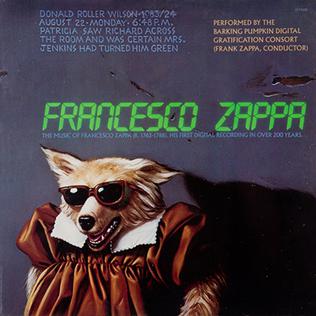
This might all sound like a case of other people doing all the work only for Frank to screw with it and call it his own, but Francesco Zappa is actually quite listenable, toe-tappingly catchy, and very pleasant. It’s chamber music, with no jokes, and no irony, other than the fact that there was once another Zappa writing music not a lot of people got to hear. As hinted at on The Perfect Stranger, the sounds used evoke Switched-On Bach. Plus, there’s that dog again on the cover.

So is this just a vanity project? Probably. Would anyone care about this music if Frank hadn’t made it available? Well, the man really did exist, and other pieces have since been exhumed and recorded by actual classical ensembles. Is it essential? Hardly. Is it historically important? Only in the context of Frank’s journey with the Synclavier. Is it worth hearing? Sure. And there you go.

The Barking Pumpkin Digital Gratification Consort Francesco Zappa (1984)—3

Tuesday, August 13, 2019

Kinks 15: Everybody's In Show-Biz

Ray Davies’ fascination—some might say obsession—with America continued, somewhat on the next Kinks album. This time it was a double, the band’s first, not counting Kronikles. Everybody's In Show-Biz (sometimes with the subtitle Everybody’s A Star, sometimes without) presented two sides of music mostly complaining about the drudgery of touring, and another two recorded at Carnegie Hall during one such recent tour. It’s not an easy listen.

“Here Comes Yet Another Day” would be a decent on its own, but the theme had already been covered in “This Time Tomorrow”. Only three years later the band’s sound has been upgraded with the inclusion of a horn section, although the music is reduced to two chords, it’s still a decent groove. Then it’s off to the drunken music hall sound that dominates the rest of the tracks, beginning with the greasy food litany of “Maximum Consumption”, but at least Dave Davies shows up for some harmonies. “Unreal Reality” begins even slower and drunker; it speeds up, thankfully, but the horns take up the mix. “Hot Potatoes” sees the brothers trading verses from the point of view of someone pointedly not in the jet set beseeching his wife for sweet lovin’ over fancy cookin’. Kill the horns and speed it up, and perhaps we’d have something. “Sitting In My Hotel” returns us to the sad rocker in the stated location, acknowledging just how petty he’s being in the face of things. Frankly, it’s lovely.

He’s back to whining about food on “Motorway”, but you’d think for all the time he’d spent plodding across America he’d’ve picked up that it’s called a highway. Dave gets a song of his own, and while “You Don’t Know My Name” is within the concept of touring, his perspective is refreshing, though we could do without the Canned Heat flute. “Supersonic Rocket Ship” pairs the music of “Apeman” with the getaway dreams of “Holiday In Waikiki” and “I’m On An Island”, then “Look A Little On The Sunny Side” is back to vaudeville, with a tuba holding the bass and a single parade drum providing the percussion. But the listener’s patience is rewarded with the lovely “Celluloid Heroes”, a song that celebrated the fading stars of Hollywood a whole year before “Candle In The Wind”, and an overt admission that Ray fully understands that the illusions of the big screen are just those.

Pairing those songs with a snapshot of a recent gig may be designed to add some conceptual commentary, but mostly it gives the band and their label a chance to double dip into the royalties. Still, for all his neuroses, Ray is quick to give credit to the people onstage beside and behind him. They start energetically with “Top Of The Pops”, and the horns add a new level to “Brainwashed”. But then the drink starts to get to Ray on a bizarre snippet of the show tune “Mr. Wonderful”, which sets up “Acute Schizophrenia Paranoid Blues”, and the rest of the set concentrates on songs from Muswell Hillbillies. There are detours through Harry Belafonte’s “Banana Boat Song” (aka “Day-O”) and “Baby Face”, and we’re left with a couple minutes dedicated to the end of “Lola”, mostly sung by the audience.

Being such a long album, the first reissue only had room for two live extras, including a version of “Til The End Of The Day”, which makes the most of the stop-start riff to welcome folks to the show. For the deluxe edition two decades later, a second disc added those plus eleven more live performances—including five alternates from the original album—plus four session outtakes. (Of those, “History” is a nice new discovery, sung straight without irony or horns. “Sophisticated Lady” would emerge on the next album under another title, but here’s it’s a harmless instrumental with guitars.) If anything, the expansion proves that they were still a decent live band. That is, when they weren’t too drunk to play.

The album was expanded again for its 50th anniversary in tandem with Muswell Hillbillies in a box that included a handful of the extras from the 2016 edition on LP only; the single CD had to make do with only a modern mix of “Celluloid Heroes”. Further remixes appeared in the big box, along with a Blu-ray containing a 15-minute home movie.

The Kinks Everybody's In Show-Biz—Everybody’s A Star (1972)—2½
1998 Konk CD reissue: same as 1972, plus 2 extra tracks
2016 Legacy Edition: same as 1998, plus 15 extra tracks
2022 50th Anniversary Edition: same as 1972, plus 1 extra track

Friday, August 9, 2019

Joni Mitchell 21: Travelogue

The idea of Joni Mitchell doing a standards album three decades into her career may have been tough to swallow, but the final result turned out to be quite palatable. So for her next trick, she decided further the experiment on “A Case Of You” and “Both Sides Now” to recast even more of her own material with orchestral arrangements.

Apparently anything worth doing is worth overdoing, so Travelogue runs over two hours. Right there it’s a lot to take in; plus, unlike established standards that have already been arranged in dozens of ways, most of Joni’s material already exists in definitive form as her original album tracks. That said, many of the selections are deep cuts, so people hearing the songs for the very first time may enjoy these versions more than those of us more familiar with them might. The selections come from eleven of her albums; of those, Wild Things Run Fast is represented by four tracks (ex-husband Larry Klein did the arrangements, so maybe that one is special to him.)

Some of the more percussive treatments sound like mid-‘70s Tom Waits, while “Sex Kills” is lashed to a rhythm akin to “On Broadway”. There’s a choir here too; unobtrusive on “Slouching Toward Bethlehem”, it works on “God Must Be A Boogie Man”, but not so much on “Sire Of Sorrow”. The louder tracks can be jarring so soon after softer ones, again making the two-hour journey arduous. The Hejira remakes seem to be the most faithful, and the look all the way back to “The Dawntreader” is also lovely. “The Last Time I Saw Richard” has something of a wandering arrangement, but her voicing of the waitress’s one line cheapens it. “Woodstock” is given an even more extended approach than hers, and certainly from CSNY’s version; we find it meandering. “For The Roses” gets a dramatic overhaul, wherein she really explores each line, just as “Cherokee Louise” is given a heartbreaking treatment, as befits the lyrics. “The Circle Game” ends the program gorgeously, with wonderful sax trills from Wayne Shorter, making for as moving as closer as “Both Sides Now” was on her last album.

In some ways Joni was ahead of the curve, as the years since have seen several artists go the “orchestral re-imagining” route a la Travelogue. Cynics suggest such a project happens when an artist has run out of ideas; in Joni’s case, she said she was done with the record business anyway. She wasn’t, but we didn’t know that then, and neither did she.

Joni Mitchell Travelogue (2002)—3

Friday, August 2, 2019

Mary Hopkin 3: Those Were The Days

Even though she hadn’t had a hit in a few years, somebody still cared about Mary Hopkin at Apple, which nicely capped off her stint there with a compilation. Save the title track, which was of course included on the US version of her first album, Those Were The Days collects several songs that were only ever released as singles, some of which actually charted. Besides “albumizing” several songs, it presents something of a link between her two proper LPs.

“Que Sera Sera” and “The Fields Of St. Etienne” were produced by Paul McCartney, and feature him and Ringo playing. These were also the last tracks she recorded before moving on to producer Mickie Most, whose song choices were even more single-minded. But for her voice, “Think About Your Children” and “Knock Knock Who’s There” might as well be the Partridge Family. “Temma Harbour” attempts to evoke musical echoes of various tropical islands without focusing on one. “Lontano Degli Occhi” continued the strategy of making her a multilingual superstar; this particular Italian pastry has a certain “Feelings” quality. “Heritage”, written by Gallagher and Lyle, is much more suited to her comfort level. (The album also included “Goodbye” and “Sparrow”, both of which have been appended to the Post Card reissue, as was “Kew Gardens” to Earth Song/Ocean Song.)

Much of the Apple catalog went forgotten after the label became inactive, and the non-Beatle artists went various ways. The Apple reissues of the early ‘90s included Mary’s first two albums alongside the likes of Badfinger, James Taylor, and Billy Preston, but—in the US anyway—interest thawed, so several titles were only released in the UK, including an upgrade of Those Were The Days. She actually had a hand in compiling the CD version, which collected further stray singles and B-sides that fell off the original LP, and added three tracks from Earth Song/Ocean Song (one of which actually was a single) plus one outtake from same. Just as the LP, it presents all sides of her repertoire, for better or for worse, and while its lack of availability today unfortunately leaves some gems buried once again, the label can’t blamed; she didn’t like them anyway.

Mary Hopkin Those Were The Days (1972)—3½
1995 UK CD: same as 1972, plus 6 extra tracks

Tuesday, July 30, 2019

Rush 16: Presto

Rush had tended to use the quarterly live album as a bookend, suggesting that the band’s next album would be an evolution, a new phase of the band, if you will. In the case of Presto, a marked de-emphasis on synthesizers was accompanied by a brand new contract with Atlantic, which they expected would give it, and the band, a push to the turn of the century.

“Show Don’t Tell” was an ideal intro, being the first track promoting the album, and the opener. Near-flamenco flourishes by every instrument carry understated verses designed to highlight the catchy choruses. “Chain Lightning” doesn’t stand out very much, until the chorus starts to sound too much like that of “Limelight”, and frankly, the pitch-altered “that’s nice” at the end is just odd. The next two songs solidify their role as spokesmen for suburban teens, continuing ideas first begun on “Subdivisions”: “The Pass” concerns teen suicide, pointedly against it, Alex’s little solo adding a feeling of triumph before the futility of “Christ what have you done”, whereas “War Paint” is a little more upbeat, dismantling the ideas of personal image and superficial vanity. “Scars” is built around an insistent African-style rhythm, with more lyrical references to “atmospheric changes”. The title track’s metaphors are a little forced, and Neil’s lyrics seem more self-reflecting than universal.

“Superconductor” is somewhat mindless, but it was designed that way, being a commentary on the disposable pap that always seems to sell millions of copies. Perhaps to prove their point, “Anagram (For Mongo)” doesn’t reference Blazing Saddles further than the title; rather, the wordplay reveals a series of adages, some clever, some forced. Lest we think they’re all about having fun, “Red Tide” crams concern over a variety of contemporary ills (acid rain, AIDS, the ozone layer) into one track, and “Hand Over Fist” extols cooperation over individual isolation. (Plus, the images of rock, scissors, and paper in the packaging inspired debate over which symbol corresponded to which band member.). Finally, “Available Light” starts with a very basic (for them) piano theme, but doubles the speed for the choruses, which culminate in throwbacks to Geddy’s high-pitched wailing.

Presto is a harmless little album, not exactly groundbreaking, but certainly reasserting the brand. All the elements are there, from the heavy riffing and polyrhythms to the literate lyrics and Geddy’s voice. Keyboards are still in there, but they don’t dominate. These days it sounds a little slick, but not as dated as other albums. (As for the cover art, it’s just plain goofy, illustrating the title track with an unconscious allusion to Watership Down.)

Rush Presto (1989)—3

Friday, July 26, 2019

Grateful Dead 11: Skeletons From The Closet

Now that the Dead had ran off and started their own label, Warner Bros. did the smart thing and put together a hits album. Skeletons From The Closet purported to present the “best” of the band’s albums, and while the band didn’t have a lot of hit singles per se, most of the tracks here have since become staples on Classic Rock radio. The usual suspects are here: “Truckin’”, “Sugar Magnolia”, “Uncle John’s Band”, “Casey Jones”, “Friend Of The Devil”. There are a few curveballs, such as “The Golden Road”, which opened the debut and sounded incredibly dated then even then; “Rosemary” seems a little odd too. An edit of “Turn On Your Love Light” and “One More Saturday Night” give a glimpse at the band onstage, and while “Mexicali Blues” from Bob Weir’s solo album does have the band playing on it, those horns will harsh your mellow.

It’s a solid set, and likely one that will lead a newbie deep into the catalog. A decade after its release, next-generation high school Deadheads were required to have a Skeletons From The Closet cassette with them at all times; the tape itself was usually on constant autoplay in the car, and the case was sized right to stash a joint.

One record’s worth of tunes wasn’t enough to sum up the band, of course, so three years later—just in time for their next label switch—Warner put out a double LP, also incorporating “best of” in the subtitle. What A Long Strange Trip It's Been used the extra space to further explore their work onstage as well as in the studio. As before, Workingman’s Dead and American Beauty get the most dipping. “Truckin’” is repeated from Skeletons, likely because it was the source of the set’s title, but they kindly included the rare single versions of “Born Cross-Eyed” and “Dark Star”. The “studio” half was supposed to include the Bear’s Choice version of “Black Peter”, but our copy has the studio version (since rectified for CD and streaming). Along with an edit of “St. Stephen” from Live/Dead, sides three and four sample the “Skull & Roses” album and Europe ‘72.

It’s hard to determine the audience for this; diehards had to have it for the two rare tracks, while we’d assume that the recently converted might have already delved into the original albums too. Still, the cassette version crammed it all onto a single tape, for further convenience.

Grateful Dead The Best Of Grateful Dead: Skeletons From The Closet (1974)—4
The Grateful Dead
What A Long Strange Trip It's Been: The Best Of The Grateful Dead (1977)—3½

Tuesday, July 23, 2019

Genesis 16: We Can’t Dance

It had already been five years since the last Genesis album, their longest stretch yet. In that time, Phil Collins had several more hit singles, another solo album, and a major tour, while Mike “+ the Mechanics” Rutherford spawned his own hit with “The Living Years” and nobody cared about Tony Banks’ solo album, nor even Bankstatement, his collaboration with Steve Hillage of Gong. Yet somehow the three of them managed to write and record a dozen songs in the space of six months, and We Can’t Dance appeared right on the cusp of grunge. As had been happening over the previous decade, only the absence of horns makes the album seem less like a Phil Collins solo album; their weakness for “wacky” videos for the more upbeat (read: radio-friendly) tracks also detracted from the songwriting.

The lyrics are also less vague, encroaching even more on social commentary, which frankly, had never been their strong suit. Wisely, the album begins with the brooding “No Son Of Mine”; while it does address domestic turmoil, the darker tone evokes good memories of the “Mama” album. “Jesus He Knows Me” is mildly catchy, but overtly skewers televangelism, and evokes uncomfortable memories of “Illegal Alien” or “Anything She Does”. But just to throw people off track, “Driving The Last Spike” is their first lengthy historical epic since the mid-‘70s, but turns toward a more contemporary sound over its ten minutes, despite the 19th-century subject matter.

While not specifically the title track, “I Can’t Dance” pretty much unravels any attempt to take the band seriously, with both the lyrics and literal video making fun of the then-current trend in music videos and soda commercials, despite their own participation and the fact that Phil had already done it quite well in the clip for “Don’t Lose My Number”. “Never A Time” is the requisite ballad, and a nice one, with echoes of adult contemporary Eric Clapton and far enough away from “People Get Ready” to keep from being sued. Then “Dreaming While You Sleep” spends far too long with a drum machine and bluesy noodling to get its point across (to wit: hit-and-run drivers will be cursed with guilt forevermore).

While Mike Rutherford’s Rickenbacker 12-string reappears after too long a wait, the mild samba rhythm and upbeat tone of “Tell Me Why” brings forth only more hand-wringing over social injustice. “Living Forever” provides an ironic contrast in its resistance to being told what to do and how to live, carried by a truly infectious backing and an extended ending that, again, recalls the mid-’70s. Despite being a single, “Hold On My Heart” is the “In Too Deep” of the album, and redundant after “Never A Time”.

As if “Tell Me Why” wasn’t enough, “Way Of The World” asks more child’s questions about why modern life is just so hard and cruel. And maybe we’re just sentimental, but “Since I Lost You” works despite its wrenching delivery and inspiration (the recent death of Eric Clapton’s young son, with some Slowhand-style leads to boot). So it really takes balls to end with yet another ten-minute epic, but “Fading Lights” is much preferable to “Driving The Last Spike”, and we still expect the chorus to go into “Ripples”. Tony’s extended solo in the middle is worthy of his best, and hindsight has brought a certain poignancy to the track, being the last studio track this version of the band released.

Basically, We Can’t Dance is a long and tiring listen; delete a few of the songs and cut others short and there’s the possibility of a strong set here—slight, but possible. The converted didn’t care, and promptly bought millions of copies and almost as many concert tickets, which in turn sold more copies of the album.

Genesis We Can’t Dance (1991)—2½